
Quicklime vs Portland Cement for Soil Drying: A Binder-Efficiency Comparison
Based on midpoint results from internal Mintek soil-drying observations, quicklime delivers approximately 2.3 times the drying efficiency per ton of binder: approximately 420 gallons of equivalent water reduction per ton of quicklime compared with 180 gallons per ton of Portland cement.
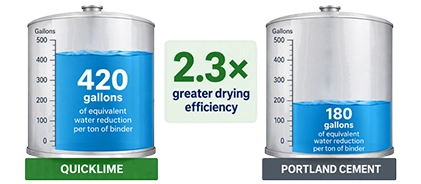
This performance-based comparison is especially useful when treatment rates differ because it focuses on the drying achieved rather than simply the pounds of material applied. The chemistry behind that difference begins with the hydration of calcium oxide.
Get back to work with less downtime.
How Quicklime Dries Wet Soil: The Thermochemistry of Calcium Oxide
High-calcium quicklime contains a high concentration of calcium oxide (CaO).
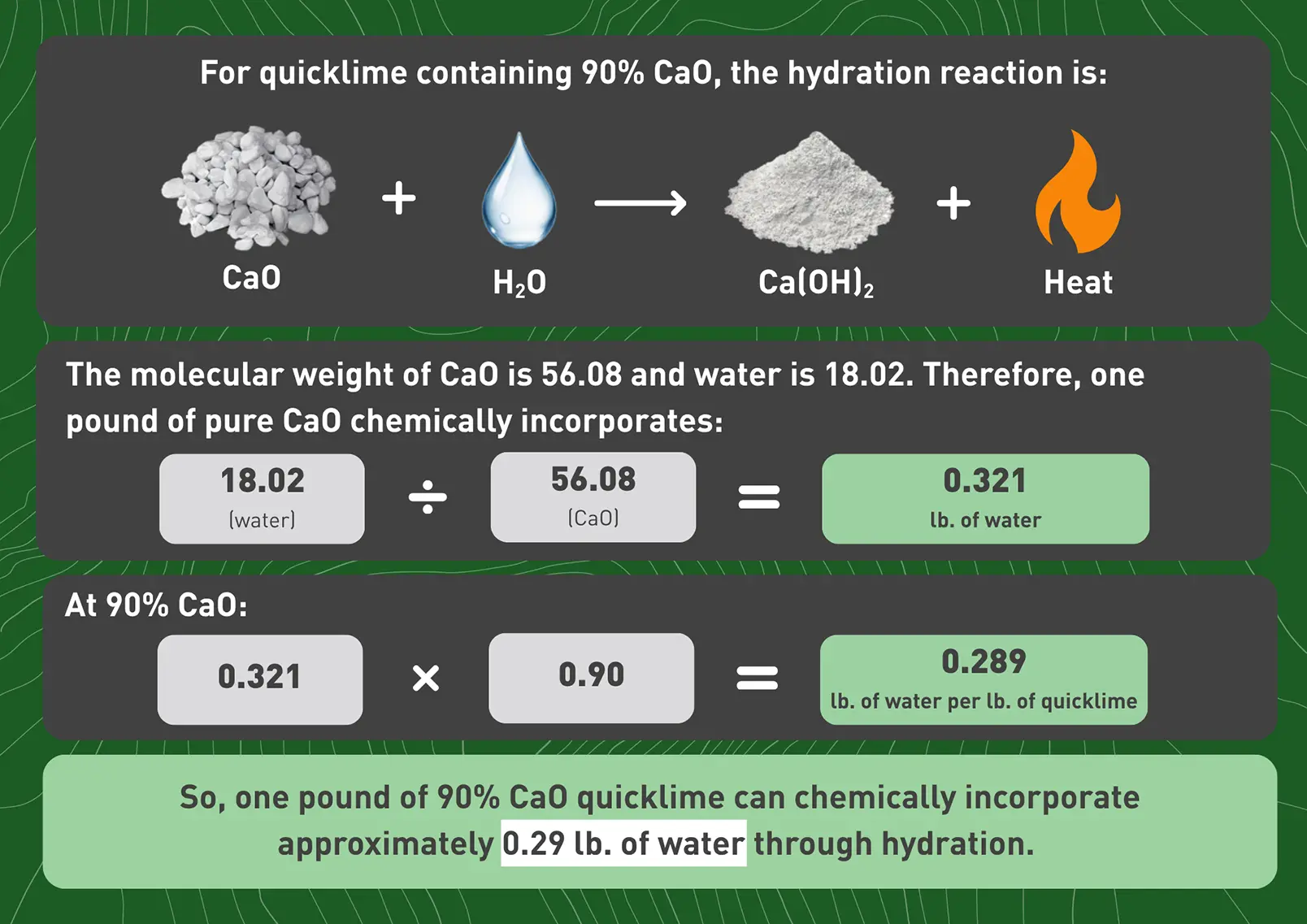
0.29 lb chemically incorporated + up to 0.40 lb evaporated
= ~0.69 lb water per lb quicklime
How Portland Cement Compares for Soil Drying
Portland cement also binds water and produces heat as it hydrates. At complete hydration, a commonly used cement-hydration estimate is that approximately 0.23 lb of water per pound of cement becomes chemically combined. Cement hydration also generates heat, although considerably less per unit mass than the CaO hydration reaction.
Using a representative range of Portland cement heat-of-hydration values as a screening estimate, the additional theoretical evaporation contribution was calculated as approximately 0.10–0.18 lb of water per pound of cement. That gives a theoretical comparison of approximately:
TREATMENT MATERIAL |
THEORETICAL THERMOCHEMICAL DRYING POTENTIAL |
| Quicklime | ~0.69 lb water per lb product |
| Portland Cement | ~0.33–0.41 lb water per lb product |
On thermochemistry alone, quicklime has roughly 1.7–2.1 times the theoretical drying potential of Portland cement. This calculation is not intended to predict an exact field moisture reduction. It demonstrates the fundamental difference in drying potential between the two materials.
Watch
Dry Up Test: Quicklime vs LKD vs Portland Cement

What Type IL Portland-Limestone Cement Means for Drying
The comparison may become even more relevant as Type IL Portland-limestone cement becomes more common. Type IL contains 5–15% limestone, which reduces the clinker fraction compared with conventional Portland cement.
As a first-order clinker-dilution estimate, applying assumed limestone contents of 10% and 15% to the Portland cement thermochemical range gives approximately:
- 10% limestone: ~0.30–0.37 lb water/lb
- 15% limestone: ~0.28–0.35 lb water/lb
Compared with quicklime at approximately 0.69 lb/lb, that suggests a theoretical advantage of roughly 1.9–2.5×. This should not be interpreted as Type IL being exactly 10–15% less effective at drying. Limestone can influence cement hydration, so actual performance must be tested. As a simplified clinker-dilution calculation, reduced clinker content would be expected to widen the thermochemical difference relative to quicklime. This is a screening-level estimate, not a prediction of Type IL field-drying performance, because limestone content, cement composition, fineness, and hydration behavior can affect the result.
Drying Is Only Part of the Benefit: Solid Modification and Workability
Quicklime also reacts rapidly. When thoroughly mixed with wet soil, its hydration, heat release, and calcium-driven soil reactions begin immediately. That speed can be especially valuable when soils are above optimum moisture content (OMC) and excess moisture is delaying grading, compaction, or other construction activities.
Calcium-driven soil modification can also improve workability. Quicklime supplies a concentrated source of calcium that promotes cation exchange and flocculation-agglomeration in responsive clay soils. Portland cement can also alter clay-soil behavior through its calcium-bearing hydration system, although its reactions and performance should not be assumed to be identical to lime treatment. These changes can reduce plasticity and moisture sensitivity, improve workability, and support improvements in soil strength and bearing capacity when treatment is properly designed and applied. Importantly, modification does not necessarily remove additional water. It changes how the clay interacts with that water, so the improvement in construction workability can be greater than the measured moisture reduction alone suggests.
How Does the Math Compare with Internal Soil-Drying Observations?
In internal Mintek soil-drying evaluations, the following general ranges have commonly been observed when treatment rate and moisture content are expressed on a dry-soil basis:
- At a 1% treatment rate, quicklime: ~1.5–2.0 percentage points of moisture-content reduction
- At a 1% treatment rate, Portland cement: ~0.5–1.0 percentage point of moisture-content reduction
Using the midpoint of those ranges:
1.75 ÷ 0.75 = 2.33×
The midpoint performance ratio aligns directionally with the thermochemical comparison: both indicate substantially greater drying performance per unit mass for quicklime. The absolute values should not be compared directly. The thermochemical calculation estimates water that could theoretically be incorporated or evaporated by the reaction itself, whereas measured moisture-content changes can also reflect mixing, aeration, exposure, soil-water interactions, and test variability.
These internal observations are empirical planning ranges, not universal design values. Actual performance depends on soil type, clay mineralogy, starting moisture, treatment rate, mixing, exposure, temperature, and test method.
From Drying Rate to Binder Efficiency (Gallons Per Ton)
This performance can also be expressed as binder efficiency, or the equivalent gallons of water reduction per ton of treatment material. This provides a common basis for comparing different materials and treatment rates.
Assuming treatment percentage and moisture content are both expressed on a dry-soil basis:
MATERIAL |
MIDPOINT DRYING EFFICIENCY |
EQUIVALENT WATER REDUCTION |
| Quicklime | 1.75 lb water per lb binder | ~420 gal/ton |
| Portland Cement | 0.75 lb water per lb binder | ~180 gal/ton |
“Equivalent water reduction” converts the observed change in dry-basis moisture content to an equivalent mass and volume of water. It should not be interpreted as a direct measurement of water physically evaporated or chemically incorporated.
These midpoint values provide a practical way to compare materials when treatment rates differ, focusing on the drying achieved rather than simply the pounds of material applied.
Cost per Unit of Drying, Not Cost Per Ton
Binder efficiency also provides a more meaningful way to evaluate material cost:
Cost per gallon of equivalent water reduction =
Delivered binder cost per ton ÷ equivalent gallons of
water reduction per ton
Because each ton of quicklime can provide substantially more drying, it may have a lower cost per unit of drying even when its delivered price per ton is higher. Based on the observed 2.33× midpoint efficiency ratio:
For soil drying applications:
Quicklime break-even price = Cement price × 2.33
This relationship assumes the midpoint drying efficiencies above and excludes differences in mobilization, spreading, mixing, productivity, rework, schedule impacts, and other project costs.
This is not a pricing recommendation. Delivered binder prices vary by geography, freight, source, project size, and market conditions. Rather, it illustrates why comparing materials only on a dollar per ton can give an incomplete picture.
“Cement is cheaper” is meaningful only if cement delivers the required drying and workability at a lower total project cost. The better comparison is not simply delivered cost per ton, but cost per unit of equivalent drying, the treatment rate required, the speed of recovery, and the ability to get earthwork moving again.
Technical References
NIST Chemistry WebBook, standard thermochemical data for calcium oxide, calcium hydroxide, and water, used in the quicklime stoichiometric and reaction-heat calculations.
NISTIR 5078: Thermodynamic Properties of Water, water and steam enthalpy data used for the upper-bound heating-and-vaporization calculation.
FHWA Geotechnical Aspects of Pavements Reference Manual, soil stabilization objectives including drying wet soils, facilitating compaction, and improving workability.
National Lime Association Lime-Treated Soil Construction Manual, guidance on lime modification, soil drying, construction, and lime-treatment chemistry.
FHWA Portland Limestone Cement TechNote, Type IL composition and ASTM C595/AASHTO M 240 background.
Portland Cement Association State-of-the-Art Report on Use of Limestone in Cements at Levels of Up to 15%, limestone content and effects on Type IL cement hydration and performance.
Note: The thermochemical calculations are theoretical comparisons intended to explain the underlying mechanisms. Internal Mintek drying observations are empirical planning ranges, not universal design values. Actual results vary with soil type, clay mineralogy, initial moisture, treatment rate, mixing, exposure, temperature, and test method. Project-specific laboratory and field evaluation should determine the appropriate treatment.
We're here to help you find the best solution for your next project. Let's get started. Give me a call at 937-641-9901.

Krystan Minor
Mintek Resources
Related Posts
How Mintek’s Soils Lab Supports Smarter Geotechnical Decisions
Every successful construction project starts with understanding the ground beneath it. Whether it is a roadway, industrial development, commercial site, or large-scale soil stabilization project, existing soil conditions can significantly affect cost, schedule,...
What Is a Mellow Period?
Rethinking Lime Stabilization Timing with Modern Practice In soil stabilization and modification work, the term “mellow period” is frequently referenced and often misunderstood. It is regularly treated as a rigid, time-based requirement rather than a construction...
How to Write Effective Soil Treatment Language in Geotechnical Reports
Clear soil treatment language is critical to turning geotechnical recommendations into successful construction outcomes. Even well-prepared geotechnical reports can end up with soil treatment language that is misinterpreted or not implemented as originally intended....